Na tej stronie sa publikowane zdjecia i artykuly mojego autorstwa.Prosze o niepublikowaniebez mojej zgody.Wszystkie prawa zastrzezone.
Pokazywanie postów oznaczonych etykietą saudi women. Pokaż wszystkie posty

środa, 29 czerwca 2011

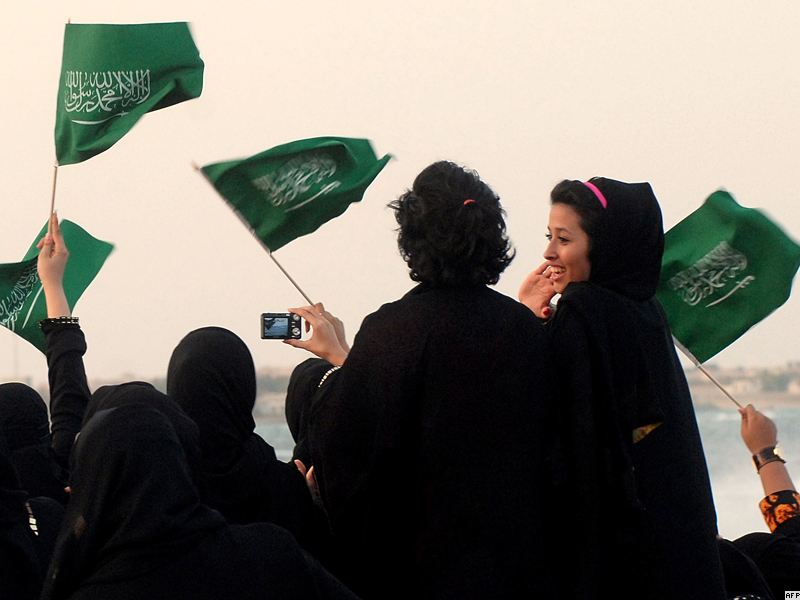
Saudi women show greater interest in sports and games

Sports and games are becoming popular among women in the Kingdom with increasing awareness that they play a key role in having a sound body and mind.

Basketball, volleyball and tennis are popular among Saudi women.

The final of a women’s basketball championship was played in Jeddah on Sunday. Eight teams representing universities and schools participated, with a large number of spectators present. Lipton, sponsor of the championship, served green tea and distributed prizes to the women spectators.

The huge presence of mainly young women spectators, as was the case at previous matches conducted at different times of the year, reveals the deep interest the younger generation has in sports.

 more http://arabnews.com/saudiarabia/article463435.ece

sobota, 11 czerwca 2011

“Treat Us Like Adults”: Saudi Women Demand Basic Rights

Six women 
arrested for driving 
in Riyadh

(Reuters, AFP)


Saudi authorities detained six women on Thursday for driving cars in the capital in defiance of laws allowing only male motorists on the kingdom’s roads.

Saudi Arabia has no formal ban on women driving. But as citizens must use only Saudi-issued licences in the country, and as these are issued only to men, women drivers are anathema.
Outcry at the segregation has been fuelled by social media interest in two would-be female motorists arrested last month.
Rasha Al Duwaisi, one of those detained on Thursday, put the ages of the group at between 21 and 30 and said they had met in Hettein district of Riyadh late in the afternoon to teach each other how to drive using three cars.
They were quickly taken to a police station in Sahafa street and instructed to summon “male guardians” to collect them from custody. “It’s not the first time we have done this,” Duwaisi said by telephone from the station.
“It’s my right to drive and my right to know how to drive. I suffer because I can’t drive because I have to rely on a driver that I share with four others.”
Many families in Saudi Arabia have at least one driver with an average salary of around 2,000 Saudi rials ($533) per month. Those who cannot afford this assign a male member of family to drive its women, which often amounts to a time-consuming burden.
Two of the other detainees were Duwaisi’s sisters, she said, adding that she met the other three on Facebook and Twitter. — AFP
Saudi authorities last month arrested Manal Alsharif, who posted a YouTube video of herself driving in the Eastern Province and calling on other women to do the same. Alsharif has been released but faces charges of “besmirching the kingdom’s reputation abroad and stirring up public opinion”.
Another woman, Shaima Osama, was also arrested for driving last month in Jeddah. She too was later released

sobota, 4 czerwca 2011

Manal moved by plight of detained housemaids


Manal Al-Sharif
By ARAB NEWS
More than a week in an Eastern Province reformatory has seen a marked change in attitude toward life for a Saudi woman who caused a stir by openly defying a national ban on women driving, Al-Watan daily reported on Friday.
“I am not an activist fighting for women’s right to drive, but a simple person leading a dignified life and looking after my kids. I’m not interested in causing controversy,” a posting on 32-year-old Manal’s Twitter page said on Thursday.
Alkhobar police arrested Manal after she drove a car on Saudi roads on May 21 in protest of the ban. She was released on Monday evening.
“I did not make any statements to anyone and will not make one. My withdrawal from activism was based on my own free will,” Al-Sahrif wrote, referring to reports carried recently by a section of the media. Manal said she planned to participate in charity activities, such as helping women prisoners she met at the Dammam Reformatory.
She said they were mostly housemaids who did not have the money to settle their debts but had completed their prison terms. They were not released because their Saudi sponsors had not cooperated in their release or deportation.
“Some of them are still in jail more than five months after the completion of their prison terms. They would go back to their home countries if they could pay for their tickets home,” she wrote.
After listening to the miserable stories behind the circumstances that landed them in jail, she has expressed determination to help them.
She has also supplied the names of some maids she met there. She said 22 of them were Indonesians who need tickets costing SR1,200 to SR1,500 each to Jakarta and other cities.
“Yani Zareena, an old Sri Lankan maid, has been in jail for the past five years, unable to settle a debt of SR36,000,” she said, adding that if anyone deposited a small amount of money against her name in the jail office, she would be that much closer to freedom.
Emi Roko Labado is a Filipino with two children who has been in jail for two years after failing to settle a debt of SR2,500, she said.
“Mother-of-two Lama Al-Eid has a debt of SR10,000. Nur Sabodin has been behind bars for the last five years, needing to settle a debt of SR17,000,” she added.
However, she called on interested donors to pay the debts on behalf of the inmates to the director of the Dammam prison, saying he was a trustworthy official.
She requested donors not to send any cash to her. “I do not collect anything, but I tell potential benefactors to go to the prison in person.”

piątek, 27 maja 2011

Germans pull out of fair over abaya

 A German tour operator pulled out of a Riyadh travel fair in protest at dress restrictions imposed on one of its female representatives, newspapers reported Thursday. Religious police demanded the German visitor change her abaya because it was decorated with red embroidery, Al-Riyadh reported. It was the first time the German, herself a Muslim, visited Saudi Arabia. Religious police, who escorted her to a taxi so that she would go and get changed, warned her not to speak of the incident but she burst out of the car “in tears”, newspapers said. The German operator protested by withdrawing from the fair. — AFP __

Manal to be held for 10 more days

wtorek, 24 maja 2011

Another woman driver briefly detained in Qassim

QASSIM: Traffic police here released a Saudi woman Monday after briefly detaining her for driving a vehicle in the outskirts of Al-Ras, a Qassim town about 370 km west of Riyadh, an official said.
A police patrol pulled over the 42-year-old woman when they saw her driving in Jandal District, said Col. Fahd Al-Habdan, spokesman of the Qassim Police Department.
The woman was driving with her 82-year-old mother and an aunt. While she has been released, her Datsun pick-up of 1985 model is still impounded, the official added.
The official said she was released “after signing an undertaking not to repeat the offense again.”
The Commission for the promotion of Virtue and Prevention of Vice (the Hai’a) was called to assist the detention of the woman.
 A witness said he used to see the woman driving every day to a desert farm to take care of her animals.
“All the neighbors know this and got used to it,” the witness added.
The incident came one day after authorities detained Manal Al-Sharief in Al-Khobar for five days pending investigation into her driving on Friday as part of her campaign to secure women’s right to drive in Saudi Arabia.
– Okaz/Saudi Gazette __

Detained Saudi woman driver appeals for bail

DAMMAM: Manal Masoud Al-Sharief, the Saudi woman detained at Dammam’s Women’s Prison after being arrested for driving a car in Al-Khobar earlier this week, has requested release on bail.
Al-Sharief’s lawyer Adnan Al-Salih, said the request was made Monday and that his client was awaiting a response from the Eastern Province Emirate.
She is being held on charges of “rallying public opinion and inciting women to drive cars”.
“The initial measures taken against her in terms of holding her for investigation for five days are regulatory,” he said.
“She had been investigated by the authority that first detained her, Al-Khobar Traffic Police, and they completed their inquiries and released her, but she has now been arrested over a ‘criminal case’,” Al-Salih said.
He said the investigator can legitimately hold Al-Sharief for 24 hours or more depending on the investigation and the nature and extent of the crime concerned.
“We are working to have her released as she is a working mother, so her detention is affecting both her job and her family,” he said.
Al-Sharief herself is reportedly calm and unperturbed at her detention, spending much of her time in conversation with other inmates. She is not being held in a single cell, and as of Monday was expecting her first visitor, her father.
A Prison Administration official said she was being treated “just like any other inmate”.
Al-Sharief, who was born in 1979 and is a divorcee with a four-year-old son, is believed to be the first Saudi woman to obtain the ISO 27701 certification from the United States as an information technology auditor. She currently works in that capacity as a supervisor at Aramco.
With a valid US driving license, Al-Sharief is said to be backed in her support for women driving by her father and brother.
— Okaz/Saudi Gazette __

Shoura to discuss law for Saudis marrying expats

 The Shoura Council’s General Commission Saturday decided a committee will discuss a draft law regulating the marriages of Saudis to foreigners. The committee assigned to study the draft law comprises a number of council members. The council’s meeting Saturday was chaired by Dr. Abdullah Aal Al-Sheikh.
The commission’s committees of Economic Affairs and Energy and Financial Affairs are also expected to discuss the 2009/2010 financial reports of the Saudi Commission for Tourism and Antiquities and the Saudi Credit and Savings Bank.
There will also be discussion of the two annual reports of the General Auditing Bureau and the bureau’s report on financial reviews and performance monitoring for the 2007/2008 financial years. Proposed legislation on healthcare and environment will also be discussed
http://www.saudigazette.com.sa/

poniedziałek, 23 maja 2011

Woman arrested in Saudi Arabia after defying driving ban

Saudi authorities have arrested a female activist who launched a campaign to challenge a ban on women driving in the conservative kingdom and posted a video on the internet of her driving.

Woman arrested in Saudi Arabia after defying driving ban
Manal al-Sharif Photo: YOU TUBE
Manal al-Sharif, who learnt to drive in the US, was arrested one day after she posted footage on the video-sharing website YouTube showing her driving in the Eastern Province city of Al-Khobar.
She was released after a few hours, but later she was taken back into custody, an activist said.
"She was detained for hours at a police station until her brother came to secure her release," said the activist, who added that the notorious religious police were called by traffic police to help in arresting Ms Sharif.
The Twitter page for Women2Drive, managed by women calling for a driving protest in June, said police arrested Ms Sharif at her home, and that she had been taken to a correctional prison, usually used for women, after a brief detention at Al-Khobar police station.
It was not clear if she was charged with any offence.
Saudi Arabia is an absolute monarchy that does not tolerate any form of dissent and applies an austere version of Sunni Islam in which religious police patrol the streets to ensure public segregation between men and women.
Women in the country are not allowed to drive and must have written approval from a designated guardian - a father, husband, brother or son - to leave the country, work or travel abroad.
The campaign Ms Sharif launched is aimed at teaching women to drive and encouraging them to start driving from June 17, using foreign-issued licences.
Ms Sharif's act of defiance came a few days after another Saudi woman, Najla al-Hariri, drove around the Western region city of Jeddah over a few days, insisting on her right to sit behind the wheel.
A group of women also defied the driving ban in November 1990, stunning Saudi men by getting in 15 cars and circling around the capital Riyadh before being arrested.
The 47 women who took part in the protest suffered severe punishment by authorities which suspended many of them from their public sector jobs and reprimanded their male guardians.
In 2008, activist Wajiha Huwaidar posted a video on YouTube showing her driving in the Eastern Province. She escaped arrest as she was lucky not to bump into police patrols.
/www.telegraph.co.uk

niedziela, 22 maja 2011

Saudi woman says she was detained for driving

From  CNN

Manal al Sharif, 32, said traffic and religious police held her for six hours Saturday after they spotted her driving. 
Manal al Sharif, 32, said traffic and religious police held her for six hours Saturday after they spotted her driving.
(CNN) -- A 32-year-old Arabian who has crusaded for women to drive in her country said she was stopped Saturday for driving a car, even though there is no law against it.
Manal al Sharif, a mother of a 5-month-old boy, told CNN that authorities released her and then tried to detain her again early Sunday.
Al Sharif supports Women2Drive, an initiative endorsing the right of women to drive and travel freely in Saudi Arabia. She said traffic and religious police detained her for six hours Saturday after they spotted her driving in Khobar. She said she was forced to sign a form promising not to drive again, and then was allowed to go home.
She told CNN that lawyers are trying to stop police from detaining her for a second time. A Women2Drive tweet later said that al Sharif and her brother had been taken from their Khobar residence to a police station.
CNN was trying to reach Saudi authorities for comment.
While no traffic laws make it illegal for women to drive in Saudi Arabia, religious edicts are often interpreted as a ban on female drivers.
Hundreds of women have joined the campaign on Facebook and Twitter to begin driving June 17. Some women with international licenses, such as al Sharif, began driving earlier.
Al Sharif recently told CNN, "We are not doing anything that is breaking the law."
Strict segregation by sex means women in Saudi Arabia can't travel without a male relative. They can't take public transport. To get around, they hire expensive drivers or taxis.
Al Sharif became frustrated after she had difficulty going home one evening.
"I had to walk on the street for half an hour looking for a cab. I was harassed by every single car because it was late at night and I was walking alone," she told CNN. "I kept calling my brother to pick me up, but his phone wasn't answering. I was crying in the street. A 32-year-old grown woman, a mother, crying like a kid because I couldn't find anyone to bring me home."
Al Sharif, who has taught other women how to drive, is resolute about Saudi women being more outspoken.
"We have a saying," she told CNN. "The rain starts with a single drop. This is a symbolic thing."

środa, 18 maja 2011

Saudi women use Facebook and Twitter to fight for equal rights


A group of women in Saudi Arabia banded together to form a movement seeking to end the country's discriminatory laws particularly male guardianship.
The Saudi Women Revolution, made up mostly of young university-educated women, was started as a Facebook page and a discussion topic on Twitter in February, by Nuha Al Sulaiman.
The Facebook page has now more than 3,000 "likes" and several of the women have met in person to discuss their campaign.
According to Al Sulaiman social media like Facebook and Twitter made possible for people who have common ideas to meet. 
According to Human Rights Watch, male guardianship means Saudi women need permission from their male kins - husband, father, brother or even son -  to work, travel, study, marry, or even access health care.
Saudi Women Revolution recently made their first public act by turning up at election centers to register for the municipal elections in September.  As expected the women were turned down.  Arab women were never allowed to vote. 
The women said it doesn't matter that they were rejected but their action was their way to get attention to their campaign. The women also wanted to be allowed to drive which is forbidden in the Kingdom.
"We will do whatever it takes. We will go to the king himself. We will never stop fighting for our rights because it's time for change," Al Sulaiman said.
The Saudi Women Revolution stressed that they are not fighting their government but just want to send the message to end women discrimination.
The campaign has already attracted support from human rights organizations outside the country.
Not all Saudi women want to end male guardianship, however. In 2009, a group of Saudi women launched a campaign called "My Guardian Knows What's Best for Me," which was participated by thousands of supporters.#30

poniedziałek, 16 maja 2011

Woman driver surprised by society's reaction

When Najla's driver unexpectedly turned in the keys and resigned, the 45-year-old Saudi housewife was left with a dilemma: He son had to get to school, there were errands to be done, and there was nobody around to drive her. So she got behind the wheel of the family car and took her son to school.
Did the world come to an end? Did society erupt in disapproval? Was she wrenched from the vehicle by a religious cop and sent back to her guardian for a lecture on morals?
No. In fact, with the exception of some looks of surprise, and a few thumb's up of approval, Najla managed to get her son to school and pick up groceries on the way home, just as countless women do the world over. It was, in the end, a banal experience.
"It is an unwanted feeling to be restrained and helpless," she told Arab News by phone. "I have three driver's licenses: two from Arab countries and an international one."
Some accused her of being an activist, trying to draw public attention to the ban on women driving in Saudi Arabia. She said the reality was she simply wanted to get her son to school, which she did two days in a row. Najla added that, contrary to what some might think, nobody paid any notice to her driving.
"Our society is civilized," she said. "Many men here respect women despite the fact that there are some men who harass women on the street, even with their drivers or with their fathers or brothers present."
She says she would like to see the day she could get a fourth driver's license: one from her own country. She points out that the ban on women driving isn't a law on the books. Indeed, government officials in the past have said this is a matter for society to decide, that there is no law that explicitly states women cannot drive.
Women who are reluctantly forced to use drivers make two points: first, the driver is an unrelated male and, secondly, it's a financial cost; drivers demand up to SR3,000 a month, not including accommodation.
"Relying on drivers has proven not to be a solution, as many women face the situation of drivers leaving their jobs, or simply the negative social impact of a driver living in the same house," she said.
Local blogs lit up with debate about Najla's action, but the expression of approval and support was clearly and strongly represented.
Recently a group announced its intention to elevate the issue with a campaign called "I Will Drive Starting June 17" which comes after a group recently sent a petition to Custodian of the Two Holy Mosques King Abdullah requesting his support for their action. The group, which currently professes to have 2,000 committed participants, echoes the government's past statements that there is no law against women driving.
For her part, Najla rejects the notion that this issue has to be elevated to an act of social upheaval, that if people thought about the issue they would easily deduce that this is simply a matter of practicality and need: “The goal is not driving itself but rather to be able to attend to our needs and not feel handicapped (by the opposition to women driving)."
arabnews

Nora varsity gives women hope

Saudi women educators and professionals were upbeat about the opening on Sunday of Princess Nora bint Abdulrahman University in Riyadh and took it as a sign women may start to assume a more active role in the Kingdom’s development.
“I hope it will lead to a massive turnaround in the fortunes of Saudi women,” said Dr. Aisha Almana, founder of Alkhobar’s Mohammed Almana College of Health Sciences. “However, universities of the world are not known by their physical structure — they attain status and credibility by what they produce. I mean a university is known by the quality of its graduates. I hope the new university will be a trendsetter. We all know that women constitute 50 percent of the Saudi population. Recent statistics, at least those from University of Dammam, indicate that there are more women graduates than men, meaning women are more aware of the need for education. They are equal partners in the development and progress of this great nation.”
Almana said Saudi Arabia should concentrate on making its people productive.
Jeddah broadcaster and newspaper columnist Samar Fatany said the new university should be a source of pride for the Kingdom. “It has bright prospects,” Fatany told Arab News. “It will inspire the young generation of Saudi women. Hopefully it will bring in a new trend of positive thinking and produce a new group of educated women who will eventually assume leadership positions in their respective fields. We need such universities to help us excel. The new university will help our women to compete with the best women in the world and create healthy competition within the various universities in the Kingdom. It will raise the benchmark of education.”
Writer and physician Dr. Samia Amoudi said: “For such a large, prestigious project to be named after a woman is an honor for all of us. It will have a great impact on society and how it perceives us women. I am very happy that our leadership is aware of our needs. They have placed their trust in us.”
“Now it’s the turn and the responsibility of the women of our Kingdom to ensure that this university attains a high rank in the world and the Middle East in particular,” said Jubail teacher Huda Al-Shehri.

http://arabnews.com/saudiarabia/article406052.ece

środa, 11 maja 2011

A Few Brave Saudi Women Dare to Take the Wheel

A Few Brave Women Dare Take Wheel Defying Saudi Driving Ban
Saudi women visit the International Luxury Motor Show in the port city of Jeddah. Photographer: Amer Hilabi/AFP/Getty Images
 
 
A Few Brave Women Dare Take Wheel Defying Saudi Driving Ban
A Saudi woman applies makeup on a model at the 2010 Cosmetic Expo, held for the first time in Saudi Arabia, at a hotel in the coastal city of Jeddah. An amendment to the labor law in 2008 allowed women to work in all fields “suitable to their nature.” Photographer: Amer Hilabi/AFP/Getty Images

Manal, a 32-year-old woman, is planning something she’s never done openly in her native Saudi Arabia: Get in her car and take to the streets, defying a ban on female drivers in the kingdom.
Manal and ten other people are organizing a campaign on Facebook and Twitter urging Saudi women with international driver’s licenses to join them starting June 17, risking their jobs and their freedom. The coordinated plan isn’t a protest, she said.
“I’m doing it because I’m frustrated, angry and mad,” Manal, who asked to be identified only by her first name, said in an interview from the eastern city of Dhahran. “It’s 2011 and we’re still discussing this insignificant right for women.”
The risk the women are willing to take underscores both their exasperation with the restrictions and the infectious nature of the changes sweeping the region. Saudi Arabia, which has the world’s biggest oil reserves, so far has avoided the mass demonstrations that have toppled the leaders of Tunisia and Egypt and threaten officials in Libya, Yemen and Syria.
“These events have taught Saudi women to join ranks and act as a team,” said Wajeeha al-Howeider, a Saudi women’s rights activist, in a telephone interview from Dhahran. “This is something they could only have learned from those revolutions.”

Male Approval

Saudi Arabia enforces the ascetic Wahhabi version of Sunni Islam. Women aren’t allowed to have a Saudi driver’s permit, even though some drive when they’re in the desert away from urban areas. They can’t travel or get an education without male approval or mix with unrelated men in public places. They aren’t permitted to vote or run as candidates in municipal elections, the only ones the kingdom allows.
The last time a group of women publicly defied the driving ban was on Nov. 6, 1990, when U.S. troops had massed in Saudi Arabia to prepare for a war that would expel Iraq from Kuwait. The Saudi women were spurred by images of female U.S. soldiers driving in the desert and stories of Kuwaiti women driving their children to safety, and they were counting on the presence of international media to ensure their story would reach the world and lessen the repercussions, according to Noura Abdullah, 55.
Abdullah was one of forty-seven drivers and passengers who stayed out for about an hour before being arrested. They were banned from travel for a year, lost their jobs for 2 1/2 years and were condemned by the powerful clergy as harlots.

Spread the Word

Now it’s “superb” that a younger generation is following in their footsteps, Abdullah said in an interview from Riyadh, the capital. She doesn’t have an international driver’s license, so she will help by spreading the word about the event with telephone calls, text messages and emails, she said.
“Their timing is perfect,” she added. “There’s momentum in Saudi Arabia now and that should help.”
King Abdullah has taken steps this year to ensure regional turmoil is confined outside his borders, pledging almost $100 billion of spending on homes, jobs and benefits. He also has promised to improve the status of women. He opened the first co- educational university in 2009; appointed the kingdom’s first female deputy minister, Nora bint Abdullah al-Fayez, the same year; and has said he will provide more access to jobs for women, who make up about 15 percent of the workforce.
A change of policy in 2008 allowed women to stay in hotels without male guardians, and an amendment to the labor law allowed women to work in all fields “suitable to their nature.”

‘Largely Symbolic’

Human Rights Watch said in January that “reforms to date have involved largely symbolic steps to improve the visibility of women.” While the United Nations ranked the kingdom in the top one-third of nations in its 2010 Human Development Report -- higher than Brazil and Russia -- its score for gender equality was much lower. On that measure, which includes assessments of reproductive health and participation in politics and the labor market, Saudi Arabia was 128th of 138 nations, below Iran and Pakistan.
The campaign Manal is helping to organize, called “I will drive starting June 17,” is the latest effort by Saudi women this year to express their desire for more rights. On April 23, a group of 15 women showed up at a registration center in the western city of Jeddah, asking to participate in the September election, the Arab News reported a day later. While they were denied entry, they were permitted to relay their demands to Abdul Aziz al-Ghamdi, the head of the district office, the Arab News said.
http://www.bloomberg.com/

niedziela, 8 maja 2011

What do women really want?

Sayidaty Magazine is about to feature different views of Arabian women from different places in the Arab world. These women will talk about the demands, views, troubles and obstacles they face in their everyday life.
“Aside from fashion, beauty and women’s achievements, Sayidaty Magazine has taken a fresh turn by shedding light on a new issue: Young women’s dreams and demands. Those young women are the leaders of tomorrow and the new faces of our world, and the magazine is going to publish the most important issues and subjects about them,” said Mona Siraj, managing editor of women’s Sayidaty Magazine.
“Sayidaty Magazine has been receiving hundreds of emails and messages from Arab women all over the world. These have been sharing their stories and views in order to find solutions to their problems,” she added.
The most significant requests and claims received by the magazine were about unemployment, spinsterhood, harassment, family disintegration and price increase, while the biggest number of women claim that Arabian women are successful in the job market.
More than one thousand Arabian young women have contributed to the magazine’s survey, giving transparent details to their stories. The survey shows that most Saudis are looking for freedom and the ability to drive a car, among other things. Emirati women claim that old traditions are tying them down, not giving them enough space to give their opinion as women.
Women from Egypt are looking to get rid of spinsterhood, addiction and illiteracy among their people. Syrian women demand equality between men and women, stating that their problems are mostly emotional.
Sayidaty Magazine has looked at all these requests and shared it with specialists, who claim that Arab women are in an anxiety phase. This happens because their dreams are not fulfilled. Arab women are waiting for a move from men and their society to give them their rights.
arabnews.com

sobota, 7 maja 2011

Saudi diamond designer wins global recognition


Saudi gems and jewelry designer Leena Al-Khiraiji has won a first in the international competition organized for gems and jewellery designing in Jeddah as part of the Saudi international exhibition of gems that was concluded here on Thursday. (SPA)

By FATIMA SIDIYA | ARAB NEWS
 A Saudi designer has won an international competition for innovative diamond designs on Thursday evening at the Saudi International Exhibition for Diamonds.
Lina Muhammad Abdullah Al-Khiraiji topped a shortlist of 15 women selected from 300 entries at the function held at Jeddah Hilton.
Announcing the result, the judging panel said Al-Khiraiji had achieved international recognition and was thus qualified to join the list of international designers and participate in any world diamond exhibition.
The judging panel comprised four experts in the field of diamonds from Switzerland, Britain and Saudi Arabia.
Al-Khiraiji studied diamond designing at a British college.
“I was happy that a Saudi woman had achieved this in one of the most important arts in the world, which is diamond designing. It has become a significant subject in international colleges and universities,” Al-Khiraiji said.
She said the idea of her winning design emanated from the rich Islamic heritage.
“I designed a bracelet in the form of the octagonal star which we see in Islamic decorations in mosques and other places of worship,” she said.
“My idea emanated from the message of Islam, which propagates love and peace. I also used the white and green colors that symbolize the banner of Saudi Arabia.” She said she was now working on new designs to represent the Kingdom in international exhibitions.
Saudi expert in diamonds, precious stones and minerals Misbah Khaled Al-Arnaouti, who was a member of the judging panel, said the competition produced a number of Saudi women capable of creativity and excellence.
He said Al-Khiraiji would be given between $5,000 and $10,000 to manufacture and market her design.
Chairperson of the exhibition Haya Al-Sindai said out of the 15 finalists, the judging panel chose three designs, of which Al-Khiraiji's came first. She said all participants would be eligible to participate in the third diamond exhibition.

czwartek, 5 maja 2011

Saudi Arabia promotes female empowerment?

Saudi arabia saudi woman 2011 5 2
Saudi women gather in front of a carpet made of over 135,000 flowers at the Riyadh Spring Festival in the Saudi capital on April 15, 2011. (FAYEZ NURELDINE/AFP/Getty Images)
Top News: In a move likely to raise eyebrows, Saudi Arabia on Nov. 10 won a seat on the 41-member board of a new U.N. panel to promote female empowerment around the world. The kingdom was nominated by a regional group of Asian countries. It is a curious development because of the extraordinary gender discrimination and segregation faced by Saudi women, who live under a system in which male guardians have the final say on many personal decisions of their female relatives. Women are not even allowed to drive in Saudi Arabia. Although the Saudi government under King Abdullah bin Abdul Aziz is seeking to give Saudi women more rights and opportunities, it is constantly stymied by the ultraconservative religious establishment. The latest setback for women came on Nov. 2 with a fatwa, or religious ruling, saying it was against Islam for women to work as supermarket cashiers. Some supermarkets have ignored the fatwa and kept their female employees on the job.
A Saudi appeals court has affirmed the death sentence for a Sri Lankan woman found guilty of murdering a Saudi infant in her care, in a 2005 incident that many see as an unfortunate accident. Rizana Nafeek was only 17 when she was hired as a maid by a Saudi family. Their 4-month-old son died while Nafeek was bottle-feeding him. The Sri Lankan government has asked King Abdullah to pardon Nafeek. It would be easier for him to do this if the Saudi family would forgive her, but so far they have not done so.
Hoping to raise public awareness about the value of early detection of breast cancer, around 4,000 mostly Saudi women created the world’s largest human pink ribbon on Oct. 28 in the port city of Jeddah. The human chain broke the previous Guinness world record of 3,640 participants set in Germany in 2007. The event was organized by the Riyadh-based Zahra Breast Cancer Association. Saudi women suffer from high rates of breast cancer deaths due in part to lack of knowledge on how to do self-exams, as well as widespread reluctance to discuss the disease with medical personnel.
Riyadh won kudos when the White House disclosed that a crucial Saudi intelligence tip led to the discovery of the cargo bombs airfreighted to the United States by an Al Qaeda affiliate in Yemen. President Barack Obama called King Abdullah to thank him for Saudi’s help. The incident may underscore what many in the West tend to forget: That the Saudis also regard Al Qaeda as a terror menace.
U.S.-Saudi ties were further strengthened by the formal U.S. announcement Oct. 20 of its intention to sell a massive arms package — potentially worth up to $60 billion — to the oil-rich kingdom. The sale, which will include 84 new Boeing F-15 fighter jets, is not expected to face significant congressional opposition, and will mean close defense and military ties between Washington and Riyadh for years to come.
Money: Saudi Arabia gave the U.S. job market another fillip a few days later, when it was disclosed Nov. 7 that the national airline had placed a $3.3 billion order for 12 Boeing 777-300 ‘extended range’ planes, with an option to buy 10 more. The purchase is part of Saudi Airlines long-term expansion strategy.
“I’m not for putting that mosque there,” says one of the richest men in the world about the Islamic Center to be constructed a few blocks from the site of the 9/11 terror attacks in New York City. Saudi Prince Waleed bin Talal is the second-largest shareholder in News Corporation, the parent company of Fox News, which has been a vocal opponent of the Center’s planned site. 
In an interview with the New York Times, the prince said he prefers a different site out of respect to the families of 9/11 victims, and because the proposed location is near a strip club.
Elsewhere: Americans have beauty queens. Saudis prefer morality queens. Zainab Al Khatam, 24, won this year’s “Miss Beautiful Morals” competition, an annual contest to select a woman who exhibits the inner beauty of “respect for her family, parents and society.” Al Khatam, who is blind, was selected because she remained at home to care for her family after completing her studies. The pageant, which does not have a swimsuit walk, has been organized by a Saudi women’s organization in part to protest the West’s stress on female physical beauty.


It’s a defense that may not do the defendant much good, even if many Saudis do believe in spirits. Charged with financial corruption, a judge on trial in a Saudi court has claimed that a jinn, or genie, made him take the bribes he allegedly pocketed in cases involving illegal land deals. The judge says the genie, who spoke through a real estate broker, put him “under a magic spell.” A lawyer for the broker insisted the genie be ordered to testify in court so the judge’s claims could be verified. That’s one trial I’d like to cover.
http://www.globalpost.com/

wtorek, 3 maja 2011

Saudi Arabia: Rights Activist, Bloggers Arrested


(Munich) - The Saudi interior minister should immediately release Fadhil Makki al-Manasif, a human rights activist arrested on May 1, 2011, in ‘Awwamiyya in the Eastern Province for taking part in peaceful demonstrations, Human Rights Watch said today. Al-Manasif's arrest follows amendments to the Press and Publications Law on April 29 that further restrict the right to free speech in Saudi Arabia, and days after the authorities arrested at least 20 peaceful protesters, including two bloggers.

"The latest arrests of peaceful dissidents brings the climate for reform in Saudi Arabia to the freezing point," said Christoph Wilcke, senior Middle East researcher at Human Rights Watch. "The Saudi ruling family has shown no signs that it might ease its iron grip on the right to express political opinions."
Al-Manasif, 27, has documented and written about human rights violations, in particular against Shi'a Saudis, for the past two years. He has documented arrests since February of participants in peaceful demonstrations in towns across the Eastern Province, such as a peaceful candlelit march by women in Qatif on April 14.
A colleague of al-Manasif told Human Rights Watch that on April 30, officers of the Ministry of Interior's Criminal Investigation Department came to his family's house to arrest al-Manasif and confiscated his father's national identity card when they did not find him there. The next day al-Manasif presented himself at the police station and was immediately taken into custody for "participating in the demonstrations."
Saudi authorities arrested more than 20 participants in peaceful demonstrations in the Eastern Province over the previous week, including two bloggers, Reuters reported. The bloggers, Mustafa al-Badr Al Mubarak and Husain Kazhim al-Hashim, had participated in and written about the protests, local sources reported. Since February, peaceful demonstrations of between dozens and hundreds of Saudis have occurred regularly to call for the release of political prisoners, predominantly in the Eastern Province. Small protests for the release of political prisoners led by women have also taken place in Riyadh, the capital, in March. The latest arrests bring the number detained since February 2011 for peaceful expression or assembly to at least 145, a Saudi human rights activist told Human Rights Watch. Human Rights Watch has confirmed at least 120 arrests before the recent arrests of more than 20 people.
The Sa‘ud family rules Saudi Arabia as an absolute monarchy. There are no elections to national institutions and no effective means of popular participation in decision making. In early March, the Interior Ministry headed by Prince Nayef bin Abd al-‘Aziz and the Council of Senior Religious Scholars, the highest law-interpreting body, reiterated a ban on all demonstrations.
On April 29, King Abdullah bin Abd al-‘Aziz issued a decree amending the 2000 Press and Publications Law, further restricting the right to free expression. The decree prohibits publishing anything that "contradicts rulings of the Islamic Sharia [law] or regulations in force," anything that "calls for disturbing the country's security, or its public order, or services foreign interests that contradict national interests," anything that "causes sectarianism or that spreads divisions between citizens," and that "damages public affairs in the country." New restrictions also include a prohibition on violating the "reputation, dignity, or the slander or libel" of the chief mufti, members of the Council of Senior Religious Scholars, or any other government official or government institution, and publishing without official consent proceedings from any investigations or court trials. A January 2011 decree extended provisions of the Press and Publications Law to online expression. Two days before his arrest, al-Manasif sent Human Rights Watch a copy of these new regulations, which the Saudi daily newspaper Al-Watan also published.

"The king's new media decree eviscerates any gains in freedom of expression under his reign," said Wilcke. "The ongoing crackdown and the media decree effectively throw the kingdom back to a time when dissent of any sort resulted in arrest."

niedziela, 1 maja 2011

YIG volunteers in bid to spread autism awareness


JEDDAH: More than 150 volunteers gathered at the Red Sea Mall in Jeddah on Wednesday to spread awareness about autism. Shoppers, doctors, volunteers and autistic children along with their families attended the event, held to mark the Autism Awareness Month.

zobacz

Related Posts Plugin for WordPress, Blogger...